Custom Search

Friday, December 10, 2010

Lost Cities, The Ruins

0 Comments

Lost Cities, the Ruins
The popular imagination is that lost cities were real, prosperous, well-populated areas, fell into terminal decline and whose locations have later been lost. Some lost cities at known sites have been studied extensively by scientists. Here introducing some Ruins of the world.


Machu Picchu (Peru)
The Lost City of the Incas
Machu Picchu ("Old Peak") is a pre-Columbian Inca city located at 2,430 m (7,970 ft) altitude on a mountain ridge above the Urubamba Valley in Peru, near Cusco. Machu Picchu is probably the most familiar symbol of the Inca Empire. It is often referred to as "The Lost City of the Incas". The site was designated as a World Heritage Site in 1983 when it was described as "an absolute masterpiece of architecture and a unique testimony to the Inca civilization".
 
Machu Picchu was constructed around 1450, at the height of the Inca Empire, and was abandoned less than 100 years later, as the empire collapsed under Spanish conquest. Although the citadel is located only about 50 miles from Cusco, the Inca capital, it was never found and destroyed by the Spanish, as were many other Inca sites.

 Over the centuries, the surrounding jungle grew to enshroud the site, and few knew of its existence. In 1911, Yale historian and explorer Hiram Bingham brought the "lost" city to the world's attention. Bingham and others hypothesized that the citadel was the traditional birthplace of the Inca people or the spiritual center of the "virgins of the sun," while curators of a recent exhibit have speculated that Machu Picchu was a royal retreat.
(Source: Wikipedia)

Angkor (Cambodia)
Contains the world's largest religious monument
Angkor served as the seat of the Khmer empire that flourished from approximately the 9th century to the 15th century A.D. More precisely, the Angkorian period may be defined as the period from 802 A.D., when the Khmer Hindu monarch Jayavarman II declared himself the "universal monarch" and "god-king" of Cambodia, until 1431 A.D., when Thai invaders sacked the Khmer capital, causing its population to migrate south to the area of Phnom Penh. 


The ruins of Angkor are located amid forests and farmland to the north of the Great Lake (Tonle Sap) and south of the Kulen Hills, near modern day Siem Reap (13°24'N, 103°51'E), and are a UNESCO World Heritage Site. The temples of the Angkor area number over one thousand, ranging in scale from nondescript piles of brick rubble scattered through rice fields to the magnificent Angkor Wat, said to be the world's largest single religious monument. Many of the temples at Angkor have been restored, and together they comprise the most significant site of Khmer architecture. Visitor numbers approach one million annually.


In 2007 an international team of researchers using satellite photographs and other modern techniques concluded that Angkor had been the largest preindustrial city in the world with an urban sprawl of 1,150 square miles. The closest rival to Angkor, the Mayan city of Tikal in Guatemala, was roughly 50 square miles in total size.
(Source: Wikipedia)


Memphis (Egypt)
Ancient capital of Egypt
Memphis was the ancient capital of the first nome of Lower Egypt, and of the Old Kingdom of Egypt from its foundation until around 2200 BC and later for shorter periods during the New Kingdom, and an administrative centre throughout ancient history. Its Ancient Egyptian name was Ineb Hedj ("The White Walls"). The name "Memphis" is the Greek deformation of the Egyptian name of Pepi I's (6th dynasty) pyramid, Men-nefer, which became Menfe in Coptic. According to Herodotus, the city was founded around 3100 BC by Menes, who united the two kingdoms of Egypt.

Estimates of population size differ widely. According to T. Chandlerm, Memphis had some 30,000 inhabitants and was by far the largest settlement worldwide from the time of its foundation until around 2250 BC and from 1557 to 1400 BC. Memphis reached a peak of prestige under the 6th Dynasty as a centre of the cult of Ptah. It declined briefly after the 18th Dynasty with the rise of Thebes and was revived under the Persian satraps before falling firmly into second place following the foundation of Alexandria.
 
Under the Roman Empire, Alexandria remained the most important city and Memphis remained the second city of Egypt until the establishment of Fustat (or Fostat) in 641. It was then largely abandoned and became a source of stone for the surrounding settlements. It was still an imposing set of ruins in the 12th century but soon became little more than an expanse of low ruins and scattered stone. The remains of the temple of Path and of Apis have been uncovered at the site as well as a few statues, including two four-meter ones in alabaster of Ramesses II. The Saqqara necropolis is close to Memphis.
(Source: Wikipedia)


Petra (Jordan)
Stone structures carved into rocks
Petra ("Rock") lies on the slope of Mount Hor (Jordan) in a basin among the mountains which form the eastern flank of Arabah (Wadi Araba), the large valley running from the Dead Sea to the Gulf of Aqaba. It is famous for having many stone structures carved into the rock. The long-hidden site was revealed to the Western world by the Swiss explorer Johann Ludwig Burckhardt in 1812. It was famously described as "a rose-red city half as old as time" in a Newdigate prize-winning sonnet by John William Burgon. Burgon had not actually visited Petra, which remained accessible only to Europeans accompanied by local guides with armed escorts until after World War I. The site was designated as a UNESCO World Heritage Site in 1985 when it was described as "one of the most precious cultural properties of man's cultural heritage."
 
Enclosed by towering rocks and watered by a perennial stream, Petra not only possessed the advantages of a fortress but controlled the main commercial routes which passed through it to Gaza in the west, to Bosra and Damascus in the north, to Aqaba and Leuce Come on the Red Sea, and across the desert to the Persian Gulf.

Petra's decline came rapidly under Roman rule, in large part due to the revision of sea-based trade routes. In 363 an earthquake destroyed buildings and crippled the vital water management system. The ruins of Petra were an object of curiosity in the Middle Ages and were visited by the Sultan Baibars of Egypt towards the close of the 13th century. The first European to describe them was Johann Ludwig Burckhardt in 1812.
(Source: Wikipedia)

Palmyra (Syria)
The Bride of the Desert
Palmyra was in the ancient times an important city of central Syria. It has long been a vital caravan city for travelers crossing the Syrian Desert and was known as the Bride of the Desert. The earliest documented mention of the city by its pre-Semitic name Tadmor, Tadmur or Tudmur, is recorded in Babylonian tablets found in Mari. Though the ancient site fell into disuse after the 16th century, it is still known as Tadmor and there is a small newer settlement next to the ruins of the same name.

Palmyra, a wealthy and elegant city located along the caravan routes linking Persia with the Mediterranean ports of Roman Syria and Phoenicia, came under Roman control. During the following period of great prosperity, the Arab citizens of Palmyra adopted customs and modes of dress from both the Iranian Parthian world to the east and the Graeco-Roman west. Tadmor is mentioned in the Hebrew Bible (Second Book of Chronicles 8:4) as a desert city built by the King Solomon of Judea, the son of David. Palmyra was made part of the Roman province of Syria during the reign of Tiberius (14–37).

 It steadily grew in importance as a trade route linking Persia, India, China, and the Roman Empire. In 634 the first Muslims arrived in Palmyra. The city was taken by the Muslim Arabs under Khalid ibn Walid in 636. In the 6th century, Fakhreddine al Maany castle was built on top of a mountain overlooking the oasis. The castle was surrounded by a moat, with access only available through a drawbridge. The city of Palmyra was kept intact. After year 800, people started abandoning the city. (Source: Wikipedia)

Pompeii (Italy)
Buried by the volcano
Along with Herculaneum, this Roman city near modern Naples was destroyed and completely buried during a catastrophic eruption of the volcano Mount Vesuvius spanning two days on 24 August year 79.
 

The volcano collapsed higher roof-lines and buried Pompeii under many meters of ash and pumice, and it was lost for nearly 1700 years before its accidental rediscovery in 1748
 

Since then, its excavation has provided an extraordinarily detailed insight into the life of a city at the height of the Roman Empire. Today, it is one of the most popular tourist attractions of Italy and a UNESCO World Heritage Site.
(Source: Wikipedia)

Palenque (Mexico)
One of Mayan's most exquisite cities
Palenque is an ancient Maya city near the Usumacinta River in the Mexican state of Chiapas. It contains some of the finest architecture, sculpture, roof comb and bas-relief carvings the Maya produced. The ancient Mayan city of Palenque, with its superb jungle setting and exquisite architecture and decoration, is one of the marvels of Mexico. First occupied around 100 BC, it flourished from about 600 to 700 AD, and what a glorious century that was. The city rose to prominence under Pakal, a club-footed king who reigned from 615 to 683 AD, represented by hieroglyphs of sun and shield, he is also referred to as Sun Shield or White Macaw.


During Pakal's reign, many plazas and buildings, including the superlative Templo de las Inscripciones (his Mausoleum), were constructed in Palenque, characterized by very fine stucco bas-reliefs. Pakal's son Chan-Bahlum II continued Palenque's political and economic expansion and the development of its art and architecture and presided over the construction of the Grupo de la Cruz temples, placing sizable narrative stone stelae within each. One can see the influence of Palenque's architecture in the Mayan city of Tikal.
 

The rival Mayan city of Toniná's hostility was perhaps the major factor in Palenque's precipitous decline after Chan-Bahlum II's death in 702. Sources speak of a devastating Toniná attack on Palenque in 730. After the 10th century Palenque was largely abandoned. In an area that receives the heaviest rainfall in Mexico, the ruins lay undiscovered until the 18th century. Frans Blom, an early-to-mid-20th century investigator remarked: 'The first visit to Palenque is immensely impressive. When one has lived there for some time this ruined city becomes an obsession.'
(Source: Wikipedia)

Somapura Mahavihara (Bangladesh)
One of the important archeological sites
Sompur Bihar at Paharpur is about 270 km by road from Dhaka. The excavation at Paharpur, and the finding of seals bearing the inscription Shri-Somapure-Shri-Dharmapaladeva-Mahavihariyarya-bhiksu-sangghasya, has identified the Somapura Mahavihara as built by the second Pala king Dharmapala (circa 781-821) of Pāla Dynasty.  

Some clay seals from the ruins bear the inscription Shri-Somapure-Shri-Dharmapaladeva-Mahavihariyarya-bhiksu-sangghasya. Tibetan sources, including Tibetan translations of Dharmakayavidhi and Madhyamaka Ratnapradipa, Taranatha's history and Pag-Sam-Jon-Zang, mention that Dharmapala's successor Devapala (circa 810—850) built it after his conquest of Varendra.

The Paharpur pillar inscription bears the mention of 5th regnal year of Devapala's successor Mahendrapala (circa 850—854) along with the name of Bhiksu Ajayagarbha.[7] Taranatha's Pag Sam Jon Zang records that the monastery was repaired and renovated during the reign of Mahipala (circa 995—1043 AD).[7] is one of the most important archeological sites in the country. It was designated a UNESCO World Heritage Site in 1985.
(Source: Wikipedia)

Ephesus (Turkey)
One of the most important cities of early Christianity
Ephesus was an Ionian Greek city in ancient Anatolia, founded by colonists from Athens in the 10th century BC. The city was located in Ionia, where the Cayster River (Küçük Menderes) flows into the Aegean Sea, and was part of the Panionian League.
 

Ephesus hosted one of the seven churches of Asia, addressed in the Book of Revelation (2:1–7). It is also the site of a large Gladiator graveyard. Ephesus was an important center for early Christianity.
 
Paul used it as a base. He became embroiled in a dispute with artisans, whose livelihood depended on the Temple of Artemis there (Acts 19:23–41), and wrote 1 Corinthians from Ephesus. Later Paul wrote to the Christian community at Ephesus.
(Source: Wikipedia)

Vijayanagar (India)
Capital of one of the largest Hindu empires
Vijayanagar, the capital of one of the largest Hindu empires ever, was founded by Sangama dynasty princes Harihara and Bukka in 1336. Its power peaked under Krishnadevaraya (1509-29), when it controlled nearly the whole of the peninsula south of the Krishna and Tungabhadra rivers. Comparable to Delhi in the 14th century, the city, with an estimated population of half a million, covered 33 sq km and was surrounded by several concentric lines of fortification. Its wealth derived from the control of spice trade and the cotton industry.  
 
Its busy bazaars, described by travelers such as Portuguese Nunez and Paes, were centers of international commerce. The empire collapsed after the battle of Talikota in 1565 when the city was ransacked by the confederacy of Deccan sultans (Bidar, Bijapur, Golconda, Ahmednagar and Berar), thus opening up southern India for Muslim conquest.
 
The ruins are set in a strange and beautiful boulder strewn landscape with an almost magical quality. The undisputed highlight, the 16th century Vittala Temple, is a World Heritage Monument. Started by Krishnadevaraya, it was never finished or consecrated; its incredible sculptural work is the pinnacle of  Vijayanagar art. The outer pillars are known as musical pillars as they reverberate when tapped. An ornate stone chariot in the temple courtyard containing an image of Garuda.
(Source: Wikipedia)
  
Sanchi (India)
The best-preserved group of Buddhist monuments
A UNESCO world heritage site in central India near the Betwa River, Sanchi is on a flat-topped sandstone hill, 90m above the countryside, and stands the best-preserved group of Buddhist monuments in India. Most noteworthy is the Great Stupa, discovered in 1818. It was probably begun by the emperor Asoka in the mid-3rd century BCE and later enlarged.

Solid throughout, it is enclosed by a massive stone railing pierced by four gateways on which are elaborate carvings depicting the life of the Buddha. The stupa itself consists of a base bearing a hemispherical dome representing the dome of heaven enclosing the Earth; it is surmounted by a squared rail unit, the world mountain, from which rises a mast to symbolize the cosmic axis.

The mast bears umbrellas that represent the various heavens. Other remains include several smaller stupas, an assembly hall (caitya), an Asokan pillar with inscription, and several monasteries (4th–11th cent. CE). Several relic baskets and more than 400 epigraphically records have also been discovered.
(Source: Wikipedia)


Absolutely all of the described ruins cities are bringing back to the lost culture & civilization in the Earth.

Tuesday, December 07, 2010

Animals which Sounds are Loudest!

0 Comments

Animals which Sounds are Loudest
In animal planet, maximum animals can make sound.  Some of those are too loudly. Here you can fine some loudest sounds animals in the world.


1. Howler Monkey
The secret behind the high-pitched voice is the monkey’s throat sac, which contains a special pocket to strengthen the voice box that used to scare other animals and people from the area and make them away from fruit trees. Well, that monkey really liked the fruit trees.


2. Kakapo
Similar to large kiwi bird is native to New Zealand and worked very hard on the breeding season. Kakapos males will create a kind of amphitheater in their own environment. Later, Kakapo be cleared, the air bag deployment in the chest, then release the high resonating voice that can be heard up to three miles away! She continued the ritual each night for four months, pumping out up to 10,000 calls.


3. Pistol Shrimp
A shrimp that break glass use snap only is the number 1 on the list of “Loudmouths”. Found in tropical reefs around the world, equipped with a pistol shrimp, in the form of large claws that shoot out a spray of water. The river water moving with such speed that creates air bubbles. After this little shell implodes, it packs a great punch, creating a huge shock. Snap the sonic also emit small flashes of light, which causes a moment in the bubble temperature soared more than 8500 degrees Fahrenheit – which is one of the hot stove you do not want to touch! 


4. Elephant
It makes sense that the world’s largest animal in land not only weighs a ton, but it makes a ton of sound too. Elephants use more than 25 different calls. Stem acting as a kind of resonating space, speakers burst out of the big lungs. Elephants can also communicate remotely with the help of Infrasound – low frequency, sub-sonic rumbling which can actually be felt through the elephant’s sensitive skin on the legs and trunk. There is a chance to tuning with each other.


5. Alligator
Technically, the alligator don’t have the vocal cords, but one surprising thing is, this does not prevent them from making noise. Crocodile hissing, snorting, coughing, growling and, most famously, under water, making infrasonic sounds that cause a small roll on the surface of the water, making it vibrate or “dance.” Although, the resulting frequency is too low for humans to hear but the voice can achieve long distance to reach your potential partner.


6. Cicada
The Cicada is probably only 1 or 2 inches, but with the “song” that can hit 120 decibels, it can also be easily the loudest insects in the world. This cicada can easily disturbing the peace, which came as a result of hard squeezing noisemakers, called timbales, which is located in the base of the abdomen.

7. Bat
When the screams of the bat’s head off, It involves an internal GPS system of that bat. High-pitched voice acting as bat sonar to help find its way in the dark, and it makes for a pretty good map. So accurate sonar, bats can distinguish objects separated by only the width of human hair, regardless of lighting.


8. Blue Whale
Whales can shout across the ocean, literally. Well, at least to the blue whale, with a sneeze that can be heard on the other side of the world. The hunchback win “Most Chatty,” with songs takes up half an hour and took more than 100 miles away. Even some whales use sound to hunt in the dark depths of the sea, diving and navigation like bats with sonar signals that can be shot with the power to paralyze the squid cannon. That’s alike some stun gun! 


9. Herring
The gas emitted by herring from their bottoms to talk with each other and to frighten predators, but at frequencies too low for people to heard. If it we can hear that, it would sound like a jet taking off. 


10. Wolf
If you go camping in the wilderness of Minnesota and you are disturbed by the cries of wolves, do not panic, though it may sound terrible, the wolf may be 10 miles away. A wolf howl can identify each other from a distance only with their own calls. When they were doing the chorus, it was intended so that the predators can not guess how many wolves they will face? Whether 1 or even 100? 


11. Northern Elephant Seal
The male makes loud sound to interest the female and chase other males. The sound can be heard from miles away. 


12. North American Bullfrog
They are the loudest amphibian, the male makes mating call for the female. The mating call can be heard from 0.5 miles away.


13. Lion
The male can roar very load to chase other males to show domination. The loudest roaring recorded can be heard from 5 miles away. 


The described animals are absolutely noticeable loudest sound creator.

Sunday, December 05, 2010

Unique Colored Mushrooms in the World

0 Comments

Unique Colored Mushrooms in the World
The types of mushrooms in the world are very. Edible mushrooms are used extensively in cooking, in many cuisines (notably Chinese, Korean, European, and Japanese). There are a number of species of mushroom that are poisonous, and although some resemble certain edible species, consuming them could be fatal.  Many mushroom species produce secondary metabolites that can be toxic, mind-altering, antibiotic, antiviral, or bioluminescent. Many species of medicinal mushrooms have been used in folk medicine for thousands of years.


1. Fly Agaric (Amanita muscaria)
These lovely-looking mushrooms are commonly known as Fly Agaric or Fly Amanita. I think this is the most popular species of mushroom because of its wonderful color. Although she's a real beauty, this mushroom is poisonous.


2. Anemone Stinkhorn (Aseroe rubra)
This unique and colorful species of mushroom is commonly known as the anemone stinkhorn and sea anemone fungus. They look lovely but they smell bad. It is a common and widespread in Australia. Found in gardens on mulch and in grassy areas, it resembles a red star-shaped structure covered in brownish slime on a white stalk. It attracts flies, which spread its spores.


3. Dog Stinkhorn (Mutinus caninus)
This brightly colored mushroom, commonly known as the Dog Stinkhorn, is often found growing in small groups on wooddebris, or in leaf litter, during summer and autumn in Europe and eastern North America. It is not generally considered edible, although there are reports of the immature eggs being consumed.


4. False Morels (Gyromitra esculenta)
This weird-looking but beautifully colored species of mushroom resembles a human brain. False Morels as it is popularly known, is widely distributed across Europe and North America. It normally grows in sandy soils under coniferous trees, in spring and early summer.
 Although potentially fatal if eaten raw, it is a popular delicacy in Scandinavia, Eastern Europe, and the upper Great lakes region of North America.


5. Turkey Tail (Trametes versicolor)
Trametes versicolor, formerly known as Coriolus versicolor, is a common polypore mushroom. Versicolor means "of several colors" and it is true that this mushroom is found in a wide variety of different colors. T. versicolor is commonly called the "Turkey Tail" in the United States because of its resemblance to the tail of the turkey bird.


6. Blewit (Lepista Nuda)
Such color of mushroom is very rare. Although the color of these mushrooms is unique they are edible. There are two closely-related species of Blewit, the wood blewit (Lepista/Clitocybe nuda) and the field blewit (Clitocybe saeva).


7. Dotted Stem Bolete (Boletus erythropus)
It's really unusual to see a colorful fungus and if you see one you will surely think twice if it's real or not. This particular species of mushroom is found in Northern Europe and North America. It is sometimes commonly known as The Dotted Stem Bolete.
 It is edible when cooked but it can cause gastric upset when raw and be confused with the poisonous Boletus satanas, which has a paler cap.


8. The Sickener (Russula emetica)
The Sickener as it's commonly known is one of the species with a predominantly red-colored cap and white gills and stalk. It gets its common name from its inedibility, as it causes vomiting and diarrhea when consumed.
It has an extremely peppery taste, which is said to disappear on cooking, along with its toxicity, though eating it is not recommended.


9. Larch Bolete (Suillus grevillei)
This glossy colored mushroom is known by 3 common names; Larch Bolete, Greville's Bolete and Bovine Bolete. This is a mushroom with a tight, brilliant and dry cap where the hymenium easily separates from the flesh of the cap, with a central stalk that is quite slender. The species has a ring or a tight-fitting annular zone. This mushroom is suitable for consumption.


10. Golden Chanterelle (Cantharellus cibarius)
Yellow, specifically golden yellow has always been one of my favorite colors. It somehow brightens my day no matter how cloudy the sky is. One thing more, the color yellow always reminds me of wealth, seeing lots of yellow things around feels like I'm surrounded by gold bars.
Chantarelle or Golden chanterelle is probably the best known species of the genus Cantharellus. It has a fruity smell reminiscent of apricots and a mildly peppery taste, and is considered an excellent food mushroom.


Here are described in shortly some of unique colored mushrooms in the world.
                                                                                                                                             Source: Wikipedia

Friday, December 03, 2010

Strangest Frogs

0 Comments

Strangest Frogs

Poison Dart Frog
Poison dart frog, like this sapphire-blue species, is the common name of a group of frogs in the family Dendrobatidae which are native to Central and South America. Unlike most frogs, species are active during the day, and often exhibit brightly-colored bodies. Although all dendrobatids are at least somewhat toxic in the wild, levels of toxicity vary considerably from one species to the next and from one population to another. Many species are critically endangered. These amphibians are often called "dart frogs" due to indigenous Amerindians' use of their toxic secretions to poison the tips of blow darts. (Link | Source)


Malagasy Rainbow Frog
The Malagasy rainbow frog lives in the rocky dry forests of Madagascar's Isalo Massif, where it breeds in shallow temporary pools found in canyons. This species is well adapted to climbing in its rocky surroundings, and can even scale vertical surfaces! When threatened, this frog will inflate itself as a defense mechanism against predators.


Transparent Frog
Hyalinobatrachium pellucidum, also called as glass or crystal frog because you can see through its transparent flesh (right down to its guts). This guy's not new, but he's definitely endangered, so the finding is heartening for environmentalists.


Atelopus Frog
The atelopus frog is known by many names such as the clown frog or the Costa Rican Variable Harlequin Toad. Whatever you call the frog, it is a neo-tropical toad that was once quite wide spread living throughout Costa Rica and Panama. The species is listed as critically endangered and is thought to be living primarily in Panama today. Photo: Paul Ouboter / Conservation International.


Red Mantella Frog
As suggested by the name, the Red Mantella has an orange/red dorsal surface. These frogs are small, reaching a size of 2.5 centimeters (1 in) in length. It is a small, terrestrial frog native to Madagascar.


Ornate Horned Frog
The ornate horned frog can grow up to six inches long and inhabits Uruguay, Brazil, and northern Argentina. While it may look like a lifeless pincushion, it's quick to lunge when lizards, small rodents, birds, or other frogs blunder by. (Source)


Chile Darwin's frog
The Chile Darwin's frog was fairly regularly seen until around 1978, since when it seems to have disappeared, and the species may now be extinct. This species, which lives in the leaf litter on the forest floor, has an unusual method of parental care; the male takes the fertilised eggs from the nest into his vocal sac where they hatch into tadpoles after approximately eight days. When he starts to feel the newly hatched tadpoles wriggling, the male carries them to a stream where he expels the young. Here they complete metamorphosis. (Source)


Vietnamese Mossy Frog
Theloderma corticale, or the Vietnamese mossy frog, is a species of frog in the Rhacophoridae family. It is found in Vietnam and possibly China. Its natural habitats are subtropical or tropical moist lowland forests, intermittent freshwater marches, and rocky areas. The common name of the mossy frog arises from the fact that its skin is a mottled green and black that resembles moss growing on rock, and forms an effective form of camouflage.


World's Smallest Frog
Generally speaking, higher altitude means larger animals. But the world's smallest known frog species lives high in the Andes Mountains of southern Peru, between 9,925 and 10,466 feet. (Source)


World's Largest Frog
The goliath frog or Conraua goliath is the largest extant anuran on Earth. It can grow up to 13 inches (33 cm) in length from snout to vent, and weighs up to 8 lb (3 kg). This animal has a relatively small habitat range, mainly in West Africa (near Gabon). The goliath frog can live up to 15 years. Goliath frogs eat scorpions, insects and smaller frogs. These frogs have acute hearing but no vocal sac.


Some people have such frog as a pet. The price of some beautiful frogs is about $45 to $75 (each).

Thursday, December 02, 2010

Amazing Colorful Tree

0 Comments

Amazing Colorful Tree

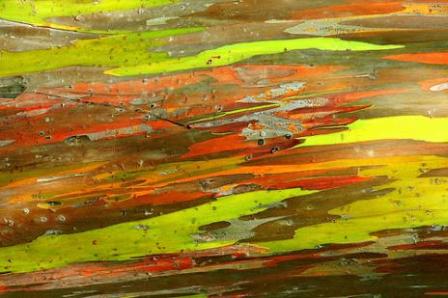
The Rainbow Eucalyptus (Eucalyptus deglupta) or Mindanao Gum is the only species of Eucalyptus tree found in the northern hemisphere. As if that weren’t extraordinary enough, the up to 70-m tall tree also shines in the colors of the rainbow: its bark can take on a yellow, green, orange and even purple shading!

The unusual phenomenon is caused by patches of bark shedding at different times. The different colors are therefore indicators of the age of the bark: Freshly shed outer bark will reveal the bright green inner bark. This darkens over time and changes from blue to purple and then reaches orange and maroon tones.

One would think that a tree this pretty and unusual should, well, if not be worshipped, at least be put on public display in parks and forests. Sadly, that is not the case. Rainbow Eucalyptus trees are cultivated around the world mainly for pulpwood creation purposes.

Wood pulp is the most common ingredient when making paper, white paper that is. The pulp can be chemically or mechanically separated from the wood. It is a dry, fibrous material whose fibers disperse and become more pliable when suspended in water.

Pulpwood’s here to stay though as it is considered a source of green energy, and demand has increased over the last few years. Currently though, trees cultivated specifically for pulp production account for only 16% of world pulp production, about 9% comes from old growth forests and the remaining 75% from second-, third- and more generation forests. That’s a lot of tree years wasted for a bit of pulpwood! However, reforestation and specific cultivation for pulp wood purposes are on the rise, making the trees a renewable energy.

If you want to spot a Rainbow Eucalyptus tree live and in all its glory, you’ll have to travel to Indonesia, Papua New Guinea or the Philippines, the tree’s only native places. However, it has been introduced worldwide as an exotic wood in South America, Malaysia, Sri Lanka, China and other countries
                                                                                                                      Source: Wikipedia

Wednesday, December 01, 2010

Some Strangest Sculptures of the World

0 Comments

Some Strangest Sculptures of the World


1.  Merlion Statue
(Singapore)
The Merlion Statue at Merlion Park is one of the best recognised icons of Singapore. It was designed by Fraser Brunner for the Singapore Tourism Board in 1964, and was used as its logo until 1997. It is a statue of a lion head with a fish body resting on a bed of waves. It is 8.6 meters tall and weighs 70 tonnes. The statue was built by the late Singapore craftsman, Lim Nang Seng. Mr Lim used broken porcelain plates to make the skin, and for the eyes, he used small red teacups, in a way, incorporating a bit of chien nien technique usually employed in temple roof designs into a modern sculpture.


2. Upside Down
Charles La Trobe Statue
 (Australia)
It stands on his head in Melbrourne at La Trobe University Bundoora.


3. Vomiting Fountain Sculpture
(London, UK)


4. Device to Root Out Evil 
(Calgary, Canada)
Designed by Dennis Oppenheim, Located in the neighborhood of Ramsay, Calgary, Canada.


5. Traffic Light Tree
(London, UK)
Designed by Pierre Vivant, “Traffic Light Tree” has 75 sets of traffic lights. The sculpture was created to mimic a tree structure and reflect the energy of the developing Canary Wharf area.


6. Skull
(Prague, Czech Republic)
A really odd sculpture, that is said to be “inspired” by the works of Kafka.


7. Engagement Rings
(Vancouver, Canada)
Two engagement rings in the ground at English Bay – must be a good place to engage. Designed by Dennis Oppenheim .


8. Skeletons in Love
(Nong Khai, N.E. Thailand)


9. Giant Tap
(Tecnopark Wintertur, Switzerland)


10. Würsa 18000 km from Earth
(France)
At a distance of 18,000 km from the earth, the elephant Wursa could balance on her trunk. It is on the basis of learned scientific calculations that Daniel Firman reached this conclusion, and came above all to produce this extraordinary work which confounds all our certainties regarding the gravitation of bodies.


Here are some of truly amazing strangest sculptures around the world. If you know about
more stranger sculptures then just share it by leaving a comments!